

Lelarge-Pugeot
Champagne
Shop Online
-
Dominique Lelarge
& Dominique Pugeot -
Vrigny, Petite Montagne de Reims
Champagne, France -
Certified Organic
Certified Biodynamic
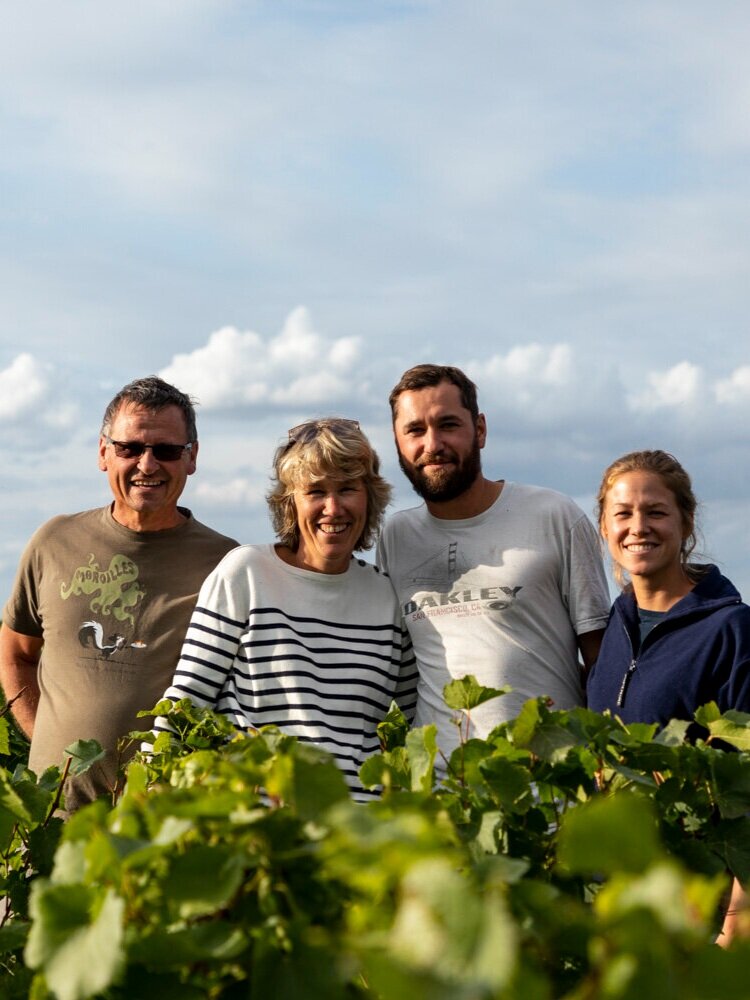
The Lelarge family have been growers in Champagne since 1799. Fast forward to 1983, when 7th generation Dominque Lelarge headed to Beaune to study and met his future wife, Dominique Pugeot. In 1985 the couple took reign of the winery, and it became Lelarge-Pugeot. Two of their three children, Clemence and Valentin now work alongside their parents.
Lelarge-Pugeot has 8.7 hectares of vines in and around Vrigny, a premier cru village located in Petite Montagne de Reims. The vineyards are spread over 40 distinct parcels, 4.4 hectares planted to Meunier, 2.8 to Pinot Noir and 1.5 to Chardonnay.
The Petite Montagne sits to the west and south-west of Reims, a series of slopes with its highest elevation of 240 meters, running from Gueux in the north to Sermiers in the south. The soils have a more complex sandy geology than the pure chalk and clay of the Montagne itself, with layers of alluvial sand and clay mixed with chalky fossils.
Much of the Petite Montagne is planted to Pinot Meunier. And for an area prone to spring frosts, it is ideally suited. The oldest Meunier vines of Lelarge-Pugeot date back to 1934.
Dominique and Dominique sought a new way of farming in 1990, begining with reducing outputs and the use of chemicals. By 2000 they had completely ceased use of herbicides and pesticides and introduced cover crops. Ploughing by horse was introduced in 2009 and in 2010 the family began the commitment to Ecocert organic certification. 2014 was a defining year of change. With half of the vineyard certified organic, Dominique decided to begin practicing biodynamics. Full organic certification (Ecocert) was realised in 2015 and biodynamic certification (Demeter) in 2017.
The region of Champagne encompasses 34,500 hectares. In 2020, a mere 6.15% is farmed in organics, and just 0.76 in Biodynamics. Of all France’s major wine regions, Champagne has the lowest percentage of organic and bio vineyards in the country (Reference Pascaline Lepeltier – One Thousand Vines) I was a little stunned when I read this, but it also highlighted the dedication and vision that the Lelarge-Pugeot family have to farming.
In the cellar, the initial fermentation is with Indigenous yeasts. Fermentation tanks are temperature controlled, enabling precision, and low amounts of sulphur are added only when necessary, and only at the pressing stage. The changes in farming have resulted in more natural sugars in the grapes, wines of more richness and structure. Resultantly it has allowed for a reduction in dosage whereby cuvees that are dosed are now extra brut, with only 2-4 gm/l maximum.
—
"THIS ESTATE HAS EARNED ACCLAIM FOR ITS RECENT AND IMPRESSIVE TRAILBLAZING WORK IN ORGANIC, BIODYNAMIC AND REGENERATIVE FARMING IN CHAMPAGNE" — WINE ENTHUSIAST STAR AWARDS 2023
“FOR EIGHT GENERATIONS, THE LELARGE FAMILY HAS BEEN FARMING IN THE VRIGNY REGION IN THE MONTAGNE DE REIMS IN CHAMPAGNE. FOR SO OLD A FAMILY, THEY ARE IN THE CHAMPAGNE VANGUARD TODAY, FARMING BIODYNAMICALLY AND AGING THEIR RESERVE WINES IN A SOLERA” — ERIC ASIMOV, NEW YORK TIMES DEC 2022
The Wines
-
Varietal Pinot Meunier / Pinot Noir / Chardonnay
Colour Sparkling White50% Meunier, 40% Pinot Noir, 10% Chardonnay. 3 years aging on lees, brut nature (no dosage).
-
Varietal Chardonnay
Colour Sparkling WhiteA vintage champagne, 100% Chardonnay, 4 years on the lees. Brut nature (no dosage).
-
Varietal Pinot Noir / Chardonnay
Colour Sparkling WhiteA vintage champagne, 50% Pinot Noir, 50% Chardonnay from a single parcel
3 years aging on lees, brut nature (no dosage). -
Varietal Pinot Meunier / Pinot Noir / Chardonnay
Colour Sparkling WhiteA vintage champagne, 70% Pinot Meunier, 25% Pinot Noir, 5% Chardonnay. 4 years aging on lees, Extra Brut 2g/l dosage.
-
Varietal Pinot Meunier
Colour Sparkling WhiteA vintage champagne, 100% Meunier, 6 years on the lees, extra brut 2g/l dosage.