

Champ des Treilles
Bordeaux
Shop Online
-
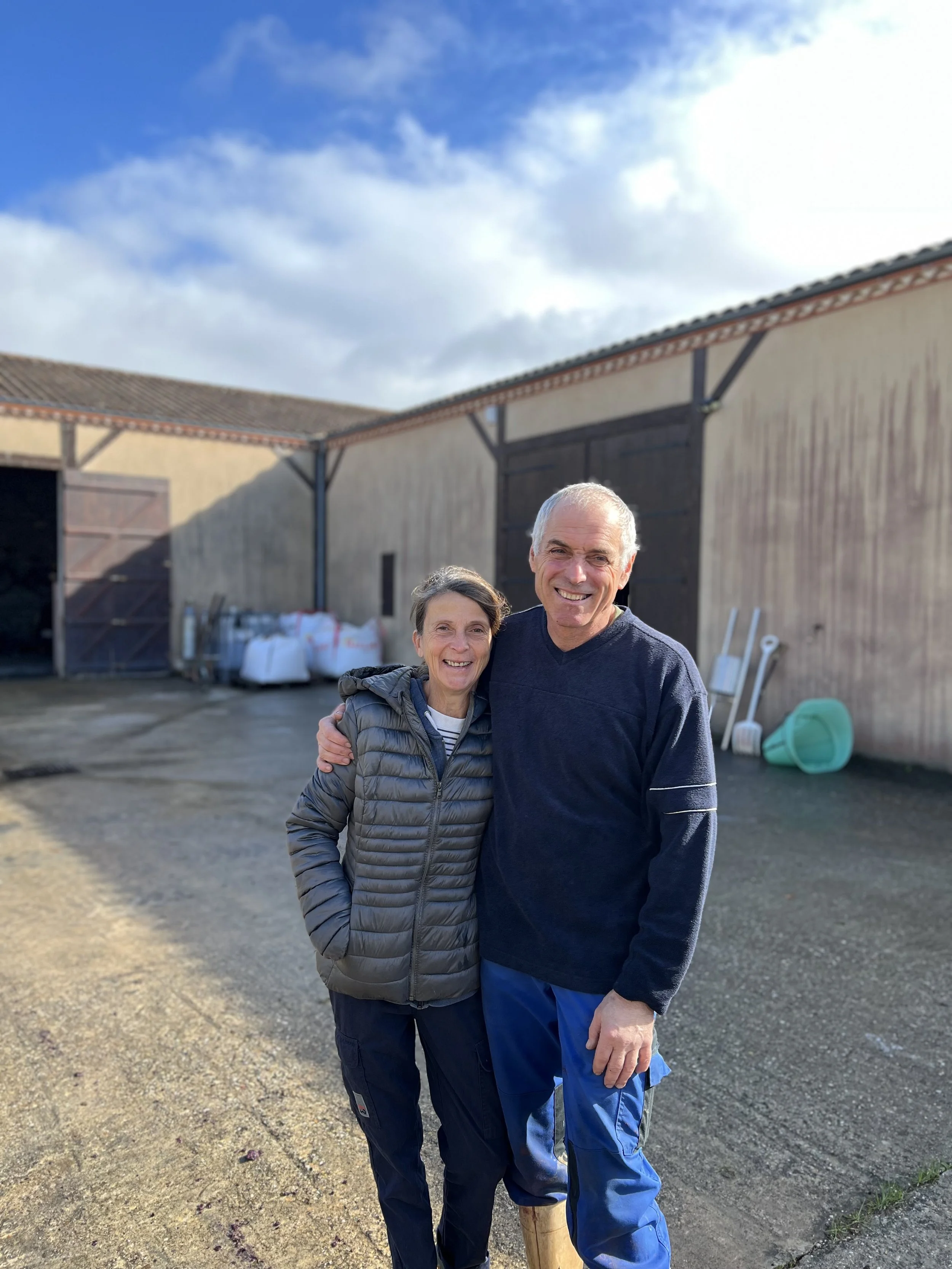
Corinne and Jean-Michel Comme
-
Margueron, Sainte-Foy
Cotes de Bordeaux, France -
Certified Organic
Certified Biodynamic
Champ des Treilles is a small Domaine run by Corinne and Jean-Michel Comme. It’s located on the easterly edge of Bordeaux in Sainte-Foy, part of the greater area of Entre-Deux-Mers.
The couple took over the estate in 1998 when Jean-Michels mother passed away. It was an opportunity to trial ideas they had about biodynamics and soil nutrition.
They credit their agricultural awakening to Francis Chaboussou, a researcher and author from the French National Institute of Agricultural Research in Bordeaux. His book published in 1980 attempted to demonstrate the positive influence of good nutrition on plants and the use of minerals. Additionally, it examined the detrimental effect of mainstream agricultural science and pesticides on soils and to the physiology of the vines.
Corrine took the lead role of the family Domaine whilst Jean-Michel remained as the technical director of the famous “Super Second” estate, Pontet-Canet in Pauillac, a position he held for 31 years, retiring in 2020.
The biodynamic work they did, and results achieved, at Champ des Treilles inspired Alfred Tesseron, the owner of Chateau Pontet-Canet, to apply these principles to their 80 hectares. Jean-Michel and Corrine quietly triggered a revolution in Bordeaux, Corrine consulting to other top estates on biodynamics and agriculture including Chateau Climens as well as Channel.
Corrine is one of the most fascinating people we have met. Whilst perusing her tincture cupboard I asked what the oyster shells were for. They provide zinc for the vines and are ground down to help fight black rot. For Corrine it is the plants that tell you what they need.
The vineyards, totalling 10 hectares, are densely planted, 5000 to 10,000 vines per acre. 7 hectares is to red varieties: Merlot, Cabernet Sauvignon, Cabernet Franc and Petit Verdot, 3 hectares to white: Sauvignon Blanc, Semillon and Muscadelle. Spread over 3 blocks, the majority of the vines are old vines, planted prior to the frost of 1956.
Soils are mostly clay and limestone, which for Corinne means earth and water, with some flint located atop of the hill.
The combination of vine age and competition being important to the overall depth and intensity of the wines and their terroir expression.
—
“THE WINES PRODUCED HERE ARE RICH WITH FRUIT AND CAN BE RELIED UPON FOR THEIR VIBRANCY, STARKLY DELICIOUS WITHOUT EVER PUTTING A FOOT ACROSS THE LINE OF OVER-EXTRACTION OR RUSTICITY. THEY PROVIDE WITHOUT A DOUBT A REASON FOR BEING OPTIMISTIC ABOUT THE FUTURE OF THE STE-FOY APPELLATION” INSIDE BORDEAUX – JANE ANSON
—
Vinifications take place with indigenous yeast, the extraction are delicate with pigeage by hand and no remontage. The use of oak was eschewed some time ago, using a spread of tanks and concrete eggs so the full expression of fruit and place can be realised.
The Wines
-
Varietal Semillon / Sauvignon Blanc / Muscadelle
Colour WhiteEqual parts Semillon, Sauvignon Blanc and Muscadelle, the fruit is directly pressed, the fermentation is slow allowing for malolactic fermentation to occur. Èlevage is in a tank and concrete eggs.
-
Varietal Merlot / Cabernet Franc / Cabernet Sauvignon / Petit Verdot
Colour Red60% Merlot, 30% Cabernet Franc, 5% Cabernet Sauvignon, 5% Petit Verdot. The fruit is de-stemmed and macerated for approximately 4 weeks. Rested in tank and concrete for 12-18 months.
-
Varietal Merlot / Cabernet Franc / Petit Verdot
Colour Red45% Merlot, 30% Cabernet Franc, 25% Petit Verdot. De-stemmed fruit is macerated for a month. The juice is èlevaged on fine lees in concrete eggs for 2 years before resting in bottle for another 18 months prior to release.